

A Boston entrepreneur who watched his mother struggle to find the right healthcare providers has built a company that’s bringing transparency to one of America’s most opaque industries.
Keith Somers launched HealthCorum eight years ago after experiencing firsthand how difficult it was to navigate the healthcare system, even in Boston’s robust medical ecosystem. At a time when consumers could easily research and review almost any purchase online, finding reliable information about healthcare providers remained frustratingly elusive.
“I just observed this lack of transparency in healthcare that contrasted sharply with other shopping experiences, where consumerism was at an all-time high. Even eight years ago when I started the business, you could go online and easily get a good understanding of what you’re buying in terms of cost and quality,” Somers said. “And that wasn’t the case in healthcare.”
The 28-year-old founder didn’t come from a healthcare background. He had just left another startup in e-commerce and had experience starting regional service-based businesses, plus sales and management roles at several prominent SaaS organizations. But he felt compelled to tackle the healthcare transparency problem head-on.
His breakthrough came when he met his co-founder through a mutual connection, who was developing technology around low-value care detection and understanding practice patterns using health claims data. Together, they assembled a team of industry veterans and built HealthCorum to evaluate provider performance based on actual outcomes rather than superficial reviews or bedside manner.

“Shortly afterwards, in addition to our provider quality scoring technology, we began to align our work around price transparency data thanks to new regulations and mandates for both payers and hospitals to actually publish their negotiated rates,” Somers said. “So that was like the second wave of how we thought about making our data even more actionable for consumers.”
The Early Sacrifices
Starting HealthCorum meant making significant personal sacrifices. While his peers were advancing in their careers, earning higher salaries and buying houses, Somers took no salary and relied on side hustles until the company secured its first clients.
“It’s foregoing some of those near-term gratifications and keeping up with your contemporaries to instead see the greater vision of what you can build and achieve as an entrepreneur,” he said.
The company faced another common startup challenge: distribution. Even with a strong solution solving a real problem, getting attention in a noisy market proved difficult.
“The reality is that there’s so much noise in the market that even if you have a great solution, getting that early traction can be a huge challenge,” Somers explained.
Finding the First Customers
HealthCorum’s first client came through an unexpected channel. At a local Boston healthcare conference, Somers met someone who ran an online forum with industry insiders. After being introduced on the email chain, one member reached out and eventually became their first customer.
“You never know what’s going to come out of one of these events,” Somers said. “The person who became our client wasn’t there at the conference, and wasn’t even operating a business I knew could be a potential customer for us at the time.”
The company’s second major client came through more intentional strategy. HealthCorum identified larger technology companies as potential channel partners who could provide scale without requiring a massive sales force. Through persistence, they secured a partnership that led to significant growth.
“We looked at the market and identified channel partners, other larger technology companies as being a good way to scale and get to a broader audience more quickly,” Somers said.
How HealthCorum Works
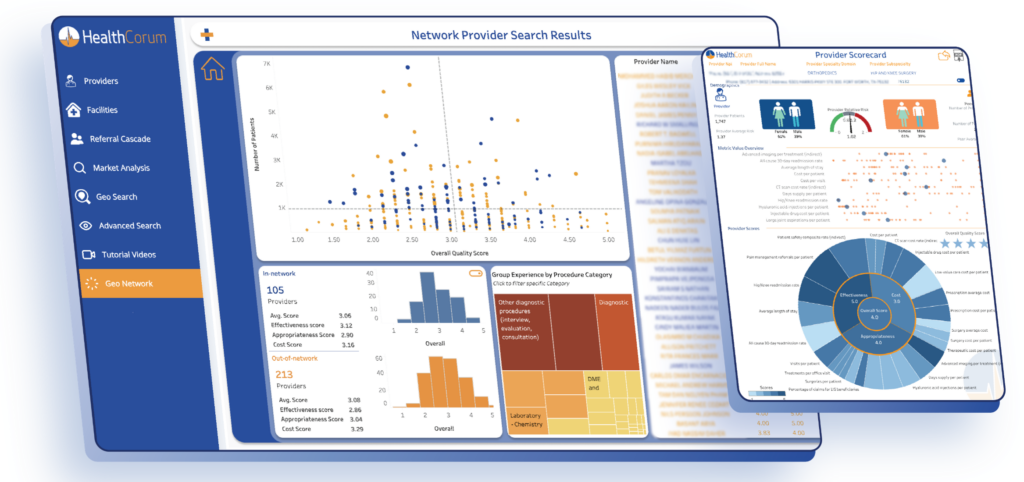
Today, HealthCorum analyses healthcare claims data to build metrics that enable unbiased scoring of providers, from primary care doctors to specialists, groups and facilities. In Boston, for example, the company creates specific peer groups for each orthopaedic sub-specialty, benchmarking individuals in the same peer group to determine who delivers the highest-value and quality care when compared to their peers.
The company sells primarily within the health plan and self-funded employer verticals, who then disseminate the information to their members and employees while using it internally to optimise provider networks and enhance referral patterns.
“It’s essentially a B2B sale with a B2C benefit through how our data gets disseminated to patients for more informed decision making,” Somers said.
Turning Profitable Through Discipline
A major milestone came when HealthCorum achieved cash flow positivity, bucking the trend of venture-backed startups that prioritise growth over profitability.
“It was an era of growth at all costs, don’t monetise, it’s all about your upside,” Somers said. “But we made the decision that we wanted to raise as little money as possible and maintain our autonomy, which we knew would require us to operate extremely efficiently.”
The turning point came after securing their first large health plan client. The revenue enabled some strategic hiring, provided a strong proof point for fundraising, and informed their product development in crucial ways.
“Once we had that engagement in flight, there was a shift in the business and we were able to accelerate more easily,” Somers said. “There was more confidence that what we had built and what we were delivering was truly hitting the mark.”
Personal Evolution
Running HealthCorum has transformed Somers personally. He started the company at 28,when he was living with friends. Around the same time, he met his now-wife. Today, he’s married with one child and another on the way.
“It takes a different level of responsibility when you’re in a marriage, it’s not just you,” he said. “The outcome of the business and what you’re doing has a major impact on your relationship.”
His family has been his biggest source of support. His wife was on speakerphone for his very first call with his co-founder. His father, also an entrepreneur, gave him latitude to sharpen his business skills from high school onward. His mother, whose healthcare navigation struggles partly inspired the company, has been a constant positive force.
“Family matters a lot when you’re on this journey. It can be difficult, you face ups and downs, and you need that support system around you to be successful.” Somers said.
Learning Through Hiring Challenges
One of the company’s biggest challenges has been hiring, particularly for enterprise sales positions.
“Knowing what to look for pre-hire, and then managing different personalities post-hire is a skill set that needs to be learned,” Somers said. “Doing it well and setting your company up for success is extremely important, because it’s a big investment when you bring on even just one person at our size.”
Somers describes his leadership style with a quote from former Patriots coach Bill Belichick: “Do your job.”
“I don’t want to be holding everyone’s hands, making sure that they’re doing their work or clocking in at the right time,” he said. “I’m more a proponent of each person taking responsibility and just do your job, get your work done.”
The Driving Vision
What keeps Somers focused is getting HealthCorum’s solution into the hands of as many consumers and healthcare organizations as possible.
“We want to see real change affected by our solutions,” he said. “This should be table stakes. You should not have to hunt for this information. It should be at your fingertips.”
The most rewarding moments come when he hears about real-world impact.
“When I hear somebody say, we learned about HealthCorum from one of our colleagues in the market, we understand it’s a great solution, or we implemented your data and we saw it actually move the needle on helping people find the right providers,” Somers said. “Hearing those stories, I think is just really special and it validates a lot of what we’ve been working so hard on.”
For Somers, success isn’t just about building a profitable company. It’s about proving that commercial success and meaningful impact can coexist.
“You can have both,” he said. “You can have commercial success while also doing something that can be really impactful and meaningful for millions of people in the U.S.”