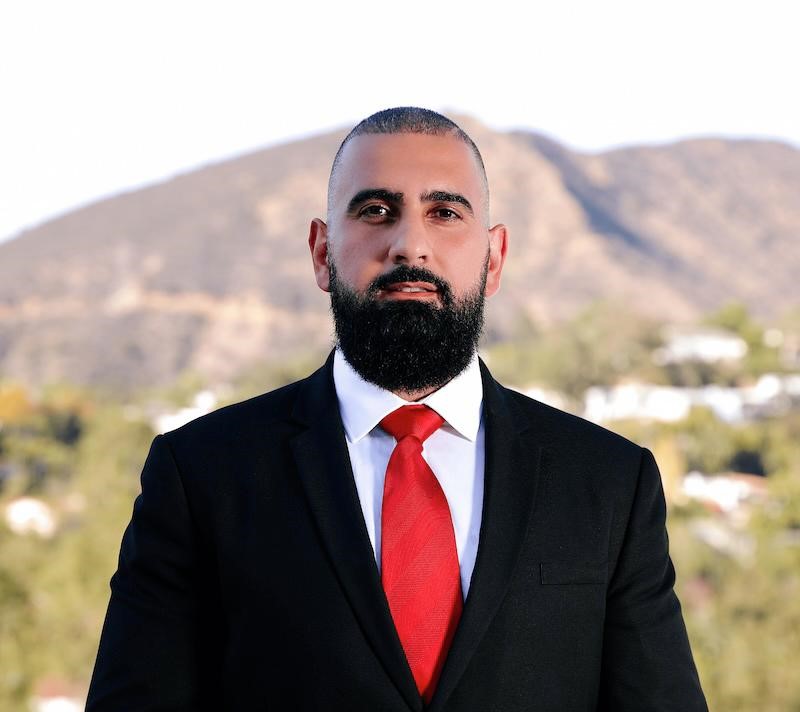
An entrepreneur who made a fortune flipping and selling second-hand phones to classmates at school is now the owner of a multi-million-dollar virtual business – despite being told he would “never make it”.
While his peers were focused on homework, Farshad was striking deals for used phones on eBay and negotiating with mobile shop workers for cheap parts.
Raised largely on his own due to absentee parents, he says being “written off” by teachers only fuelled his desire to be successful.
READ MORE: ‘I’m 17 and still in school but I make five figures a MONTH with my side hustle’
Today, the 37-year-old is the founder of E5quire Law – one of the world’s first fully virtual law firms.
And last year alone, the company secured more than $5 million in settlements for clients, all without spending a single dollar on marketing.
“I used to buy phones in bulk off eBay, refurbish them, and sell them to classmates who’d lost theirs at parties,” Farshad, who has 1.6million followers on Instagram @e5quire, said.

“I even paid $20 per empty phone box to a guy at Verizon because I could sell phones for more if they were in a box.
“I’d buy little flip phones like LG VX 4900s and Motorola Razrs for $75 and sell them for $200.
“It was a decent side hustle.”
Farshad said he learned early to rely on himself.
He said: “My mom left after my parents divorced, and my dad lived out of the country, so from the age of 13 I just figured out how to take care of myself.
“It probably sounds odd but back then, this wasn’t as much of a big deal as it would be now.
“My brother was four years older than me – he was at college an hour away.
“I decided that I was going to make myself a success.”
By his late teens, Farshad was juggling multiple gigs – including working as a DJ – while saving enough money to fund his own education.

But not everyone believed in his potential.
He said: “A teacher once said that I’m never gonna get anywhere like it was a dead end for me.
“I never got good grades – my parents were told I was going to become a troublemaker and would never amount to anything.
“But I have always been driven to make money because I wanted to both invest in my own education and be self-reliant.
“I was flipping and selling the phones to friends at school during the day to make money and then re-invest that money into the business I had going.
“I also loved music and would DJ until 4am sometimes, before driving to school at 6am.
“The regular 9 to 5 has never appealed to me – I loved the hustle.
“And now I’m a lawyer with a multi-million-dollar firm, so I’ve definitely proved them wrong.”
Despite the lack of faith, Farshad graduated from UCLA in 2010 and later earned a law degree from Pepperdine University in 2014.

But Farshad didn’t leave law school and start practising as a lawyer.
During his time at UCLA, he had become close with athletes, especially those on the football and basketball teams, through workouts and nightlife connections.
He said: “My athlete friends were encouraging me to manage them but I kept saying, ‘Guys, I don’t know what I’m doing yet. I just started law school. Give me time to figure life out.’
“I graduated law school in 2014 but didn’t take the bar exam right away.
“At the time, I was making good money as a DJ and working with athletes on off-field endorsements, so I didn’t feel the urgency.
“I was making money, I was having a good time – life was great.”
But things changed when the pandemic hit.
He said: “With Covid and the entertainment and sports industries shutting down, I had to reassess.

“I’d just come back from China with Kenneth Faried [a professional American basketball player] and I sensed a long lockdown was coming.
“That’s when I decided to take the bar exam.
“I told my wife, ‘This is gonna be a long time. I might as well take the bar.’”
When he passed, Farshad’s cousin, who owns a personal injury firm, encouraged him to open his own firm and mentored him through the process.
Farshad also had a bad experience as a client in a 2018 car accident and he felt as though the representation could have been better.
He said: “A car made a U-turn across four lanes and slammed into me. It demolished my car, all the airbags deployed – it was terrible.

“I didn’t like the way the person that handled my case handled it and going through that motivated me to do better for others.
“I felt like people should be treated better – that’s one of the reasons why I wanted to get into this field.”
And despite scepticism from some, Farshad says his dual identity as a DJ-turned-lawyer has ended up working in his favour.
He said: “I didn’t go down the billboard lawyer route.
“I built a brand first – and then opened a law firm. At first, people were like, ‘Who the hell is this guy?’
“I’d actually changed my DJ name to ‘Esquire’ before law school.
“The idea was: lawyer by day, DJ by night.
“People told me, ‘You can’t be a DJ and a lawyer.’ But all it’s done is grow the brand exponentially.”
Now based in California with his wife – who he calls “the driving force behind his success” – and their three dogs, Farshad continues to manage athletes and influencers, all while running E5quire.

He said: “I have a really big passion for cars so I’ve spent money on them, but I’m very protective of my energy.
“People puffing their chests and tapping themselves on the back – I’m not a huge fan of it.“
“I just look at my incredible, beautiful wife and I think, ‘Yeah, I made it.’”
READ MORE: ‘I’m saving £1,500 per MONTH on household bills with these simple tricks’